
Dr Ramesh Makam

sleeve-gastrectomy-vs-gastric-bypass/

Dr. Ramesh Makam

Reviewed by Dr. Ramesh Makam

Advanced Laparoscopic and Bariatric Surgeon

Medical Director, Arka Anugraha Hospital

Last reviewed: 17 September 2026

Introduction

Sleeve gastrectomy and gastric bypass are the two most commonly performed weight-loss surgeries, and both work well, so the real question is not which one is “better” in general but which one fits your body, your health conditions, and your goals. Here is a straightforward comparison to help you have a more informed conversation with your surgeon.

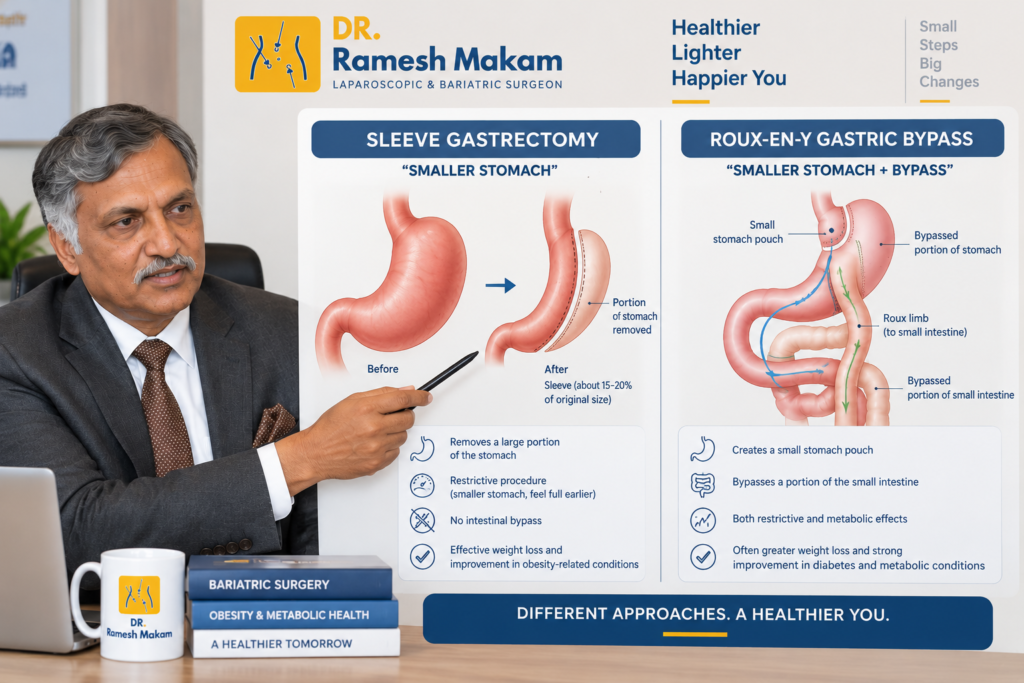
Bariatric surgeon discussing sleeve gastrectomy and gastric bypass with a patient

The Main Types of Weight-Loss Surgery, in Plain Terms

Before comparing sleeves and bypass directly, it helps to know where each one fits.

  • Sleeve gastrectomy removes roughly 75 to 80 percent of the stomach, leaving a narrow tube. This restricts how much you can eat and also removes most of the tissue that produces ghrelin, the hormone that drives hunger.
  • Gastric bypass creates a small pouch from the top of the stomach and connects it directly to a lower part of the small intestine, so food bypasses most of the stomach and the first part of the intestine. This restricts intake and also changes how nutrients are absorbed.
  • Mini gastric bypass (one-anastomosis gastric bypass) works on a similar principle to a full bypass but with one connection instead of two, which shortens the operating time.
  • Banded sleeve gastrectomy adds a silicone band around the sleeve after it is created, which helps the sleeve keep its shape over the years and lowers the chance of the stomach stretching and weight creeping back.

Sleeve vs Bypass: A Side-by-Side Comparison

Factor

Sleeve Gastrectomy

Gastric Bypass

Average excess weight loss (2 yrs)

60-70%

65-75%

Effect on type 2 diabetes

Good, often improves

Generally stronger, higher remission rates

Effect on acid reflux (GERD)

Can worsen or trigger reflux

Usually improves or resolves reflux

Reversibility

Not reversible

Technically reversible, rarely done

Complication rate

Slightly lower

Slightly higher

Operating time

Shorter

Longer

Nutritional monitoring needed

Moderate

Higher, due to malabsorption


Both procedures are done laparoscopically at most centres today, and recovery time is similar for the two, usually two to three weeks before returning to normal activity.

When Sleeve Gastrectomy Makes Sense

Sleeve gastrectomy tends to be the better fit if you:

  • Have had previous abdominal surgeries that have left scar tissue, since the upper stomach area is usually easier to access than the small intestine
  • Are at the higher end of the BMI range, where a technically simpler procedure carries less risk
  • Have significant heart or lung disease that makes a longer surgery riskier
  • Do not already have troublesome acid reflux, since sleeve can occasionally bring on or worsen GERD symptoms


The main trade-off is that weight loss, while substantial, is sometimes slightly less dramatic than with bypass, and because part of the stomach can gradually stretch over the years, some patients see slow weight regain later.

When Gastric Bypass Makes Sense

Gastric bypass is often the stronger choice if you:

  • Have type 2 diabetes, since the rerouting of the intestine changes gut hormones in a way that improves blood sugar control more consistently than sleeve alone
  • Already deal with significant acid reflux, since bypass tends to reduce reflux rather than worsen it
  • Are prepared for closer long-term monitoring of vitamin and mineral levels, since the surgery changes how your body absorbs nutrients


The trade-off is a technically more complex operation with a marginally higher complication rate and a stricter lifelong requirement for supplements.

Banded Sleeve Gastrectomy: Built for the Long Term

One limitation of a standard sleeve is that the stomach pouch can slowly dilate over five to ten years, which is one reason some patients regain weight later. Adding a band around the sleeve at the time of surgery addresses this directly. The band does not change the operation itself, and recovery is essentially the same, but it gives the sleeve a mechanical limit that helps preserve the restriction long after the surgery. This is a technique Dr. Makam has particular experience with, and it is worth discussing if long-term weight maintenance is a specific concern for you.

What to Expect: Before and After

Both procedures follow a broadly similar timeline. In the first two weeks you will move from liquids to a soft diet, most patients are back to light daily activity within a week to ten days, and most of the rapid weight loss happens in the first six to twelve months. By eighteen months to two years, weight loss typically levels off, and this is where the differences between sleeve and bypass in the comparison table above tend to show up most clearly, both in the numbers and in how you feel day to day.

There is no universally correct answer between sleeve and bypass. It comes down to your BMI, your existing health conditions, and how each procedure’s trade-offs line up with what matters most to you. Book a consultation with Dr. Makam for an assessment based on your specific profile, including whether a banded sleeve is worth considering in your case.

There is no non-surgical management.

Immediate steps include:

  • IV fluids
  • Nasogastric decompression
  • Broad-spectrum antibiotics
  • Emergency surgery

BEST Institute was started with the intention of sharing my knowledge with
other fellow surgeons. During this journey, many conferences and workshops
have been conducted. Skills training is the highlight of this Institute.

Recent Post

Appendix Operation Cost in India + Recovery: Complete Guide

Appendix Operation Cost in India + Recovery: Complete Guide

September 18, 2026 Appendix Operation Cost in India + Recovery: A Complete Guide Reviewed by Dr. Ramesh Makam Advanced Laparoscopic and…

Gallbladder Stone Laser Surgery: Is It Real? Options & Cost

Gallbladder Stone Laser Surgery: Is It Real? Options & Cost

September 18, 2026 Gallbladder Stone Laser Surgery: Is It Real? Options & Cost in India Reviewed by Dr. Ramesh Makam Advanced…

Which Size of Gallbladder Stone Is Dangerous? A Surgeon Explains

Which Size of Gallbladder Stone Is Dangerous? A Surgeon Explains

September 18, 2026 Which Size of Gallbladder Stone Is Dangerous? A Surgeon Explains Reviewed by Dr. Ramesh Makam Advanced Laparoscopic and…

Frequently Asked Questions

What is the difference between gastric sleeve and gastric bypass? +

Sleeve gastrectomy removes part of the stomach to restrict intake, while gastric bypass creates a small pouch and reroutes the intestine, which restricts intake and also changes nutrient absorption.

Which weight-loss surgery gives the most weight loss? +

Gastric bypass tends to produce slightly higher excess weight loss on average, though both procedures achieve substantial and lasting results for most patients.

Is mini gastric bypass safe? +

Yes, mini gastric bypass is a well-established procedure with a single connection instead of two, which generally means a shorter operating time while achieving results comparable to a full bypass.

Which bariatric surgery is best for diabetes? +

Gastric bypass generally shows stronger and more consistent diabetes remission rates compared to sleeve gastrectomy, due to the hormonal changes from intestinal rerouting.

Can bariatric surgery be reversed? +

Gastric bypass is technically reversible, though this is rarely performed. Sleeve gastrectomy is not reversible, since part of the stomach is permanently removed.

How much weight will I lose after sleeve vs bypass? +

Most patients lose 60 to 75 percent of their excess weight within two years with either procedure, with bypass typically at the slightly higher end of that range.

Looking for Personalised Medical Guidance?

Speak with Dr. Ramesh Makam to understand your condition, treatment options and the next steps for your care.

Consult Dr. Ramesh Makam